
Posts Tagged ‘Gordon Brown’

The Least Worst Option?

Tuesday, May 11th, 2010

An outbreak of reality seems to have broken out during today among Lib Dem MPs although, according to Laura Kuenssberg’s tweets and the Sky ticker, it took Ed Balls to treat their negotiators with contempt for them to realise that Labour were more interested in wrecking a coalition rather than creating the impossible ‘rainbow’ or ‘progressive’ coalition that an inherently unstable combination of naive Lib Dem MPs and ennobled fixers like Adonis and Mandelson ever thought might be feasible.

So in the end Clegg miscalculated and gave an impression of weakness and vacillation in his leadership that will probably undermine his power in any coalition. As this blog said this morning ‘they fail[ed] to appreciate the startling concessions on PR that they have already extracted from both main parties’ — although, in reality, Labour was cynical enough to string the Lib Dems along on their pet policy of PR while blocking on the economy and other issues, which must have been a position designed to inflict most pain on their negotiating team.

I still maintained this morning that ‘it’s potentially as likely as not that Clegg will form a coalition with the Tories as Labour but the point is still valid that he is a weak leader who has failed to take his party with him — there would certainly be dissent from both Lib Dems and far-right Tories to such a coalition.’ Ironically, such dissent is probably going to be less now after such a farcical day than might have happened previously.

The Liberals must feel like fools, having paraded proponents of the ludicrous coalition with Labour on the news channels all morning — and there were plenty of them. Only when treated with contempt by Labour did they stare reality in the face and realise, in retrospect, that initially their negotiators had rattled the Tories into giving up more than they probably actually needed to.

While Gordon Brown’s exit was choreographed to be dignified, it would have had far more integrity had he announced his intention to stand down on Friday. In the end this is probably the least worst option — some of the Tories more recklessly capitalistic ideas being moderated by the Lib Dems — and Cameron came out of the whole shambles as more statesmanlike than one might have anticipated and genuinely prepared to put national matters before party interest, which is something today’s spurious negotiations by the Labour Party showed their senior figures could not be trusted to do.

I don’t have any illusions that this will be a government that’s going to be popular — and friends have pointed out already that their austerity will hurt everyone personally. However, Labour were going to have to do that anyway and would probably have allocated the cuts in a more partisan way — at least a coalition will be less able to indulge in the poison spin of the likes of Mandelson and Campbell, who everyone should be glad to see put back in their boxes.

Let Clegg the Weak Leader Destroy His Contemptible Party in the Losers’ Coalition

Tuesday, May 11th, 2010

What doesn’t seem to be mentioned in most analysis of this disastrous election aftermath is that the current mess is related to Nick Clegg not being in control of his party. You don’t have to read very carefully between the lines to realise that Clegg and his negotiating team put together a deal and it was rejected by the Lib Dem parliamentary party.

It’s obvious that for all Clegg’s high-blown talk of putting the country’s interests first, his MPs are a bunch of self-serving, deluded opportunists who are such a disgrace to democracy that they fail to appreciate the startling concessions on PR that they have already extracted from both main parties. Their dogmatism makes even Gordon Brown look a model of enlightened flexibility. They should have made it clear before the election that, in the case of a hung parliament, the likes of Paddy Ashdown would go round spreading poison designed to sabotage any deal with the Tories. Had they been honest about being so willing to enter a coalition with Labour even in the face of such dubious parliamentary arithmetic then they would surely never have won seats in places like Burnley — or Redcar where disgust at Labour’s lack of action in preserving local steel manufacturing jobs saw a massive swing to the Lib Dems.

It can now be seen that Clegg positioning himself as the new, honest face of politics was a cynical joke. In retrospect it seems obvious that he can’t deliver the support of his own party for one of the options he refused to rule out and, as the extract from my blog post two days before the election shows, he was absolutely disingenuous by implying he could deliver an agreement either way (or, as he implied, to the party with most seats and a larger share of the vote) .   What Charlie said two days before the election:

Charlie Mackle just had two tweets featured on the listener reaction page to Jeremy Vine’s interview this lunchtime with Nick Clegg: http://www.bbc.co.uk/radio2/shows/jeremy-vine/election-debates-2010/liberal-democrats/ (one is at 1203, the other at 1242).

Both are about Clegg’s failure to spell out what he would do in the event of a hung parliament…I think he’s making a huge rod for his back by effectively deceiving some people into voting for him…One thing that the Liberal Democrats trade on is that they tend to be all things to all people — and even more so this election…campaigning in some seats as the anti-Tory party and in others as the anti-Labour party depending on the incumbents…If Clegg does not explicitly say which party he’d support in a hung parliament then his only plausible course of action would be to support the party with the largest number of seats — that’s the only real democratic outcome…Virtually any scenario is such a complete mess that it makes the case for electoral reform where the parties would have to be far more explicit about working with opposing parties once elected.

I still think it’s potentially as likely as not that Clegg will form a coalition with the Tories as Labour but the point is still valid that he is a weak leader who has failed to take his party with him — there would certainly be dissent from both Lib Dems and far-right Tories to such a coalition. However, the reasonably comfortable majority they would achieve would mean this was tolerable. Clegg is having to balance splitting his party against acting in the national interest. Cynical, tribal politicians like Brown would have no trouble deciding which way they would move but Clegg put himself on a moral pedestal which would make him look a supreme hypocrite if he put party over the needs of a stable government.

If the Tories were acting out of pure self-interest in the long-term they ought not to regret their actions if the Liberal Democrats and Labour put together this desperate coalition. After all, whoever is in government is going to have to impose some monumentally unpopular decisions or risk the country being trashed by the markets Greek style. It would be more justified if Labour carried the consequences for its own ineptitude and the Lid Dems suffered for their contempt of the electorate’s decision. When the ramshackle coalition collapsed then the Tories would likely obliterate both of these unprincipled parties — and rightly so. The problem is that we’d all suffer economically in the fall out.

I don’t particularly welcome the prospect of a Tory minority government or Tory-Lib Dem coalition either BUT any other outcome is so violently contrary to a sense of democracy and natural justice.

And it wouldn’t help the Labour party in the long term as the likes of David Blunkett have argued (Lib Dems ‘acting like every harlot in history’). I really don’t understand what motivates them apart from the naked desire for power for its own sake and the privilege and patronage that filters down to the activist and crony levels. That may explain the deeply depressing, anti-democratic attitude of Labour and Liberal activists whose tweets and comments on phone-ins seem to revel in glee that they think this gives them an opportunity to show the electorate they were wrong. I heard one on Radio Five last night. To the question, ‘didn’t Labour lose the largest number of seats since 1931 and get the lowest share of the vote since 1983) the activist said ‘Yes. But look at the NHS and how much money they’ve spent on that — and made it better as well.’

The point about a progressive coalition that consists of anti-Tory votes is risible and contemptible — fair enough if all those parties had stood at the election on a ‘progressive coalition ticket’ BUT THEY DIDN’T.

I’m encouraged that Caroline Lucas has indicated she wouldn’t sign up to a coalition and would support other parties’ policies on a case-by-case basis. I would have voted Green in my constituency had they fielded a candidate but would be exceptionally disappointed if she ended up being the one MP who perpetuated this financially and morally bankrupt regime.

Anti-Democratic, Contemptuous, Opportunist, Self-Serving, Hypocritical, Myopic, Anal-Retentive, Self-Obsessed, Deluded Scum

Monday, May 10th, 2010

I thought about posting a blog about the machinations in Westminster by the defeated coalition of losers but I thought better of it as it might risk blowing my blood pressure if I said what I really thought.

‘Be Careful What You Wish For…

Friday, May 7th, 2010

…or you just might get it’ could be applied to Nick Clegg and anyone who voted for him out of an anti- motive rather than any love of the Lib Dems.

At the time of writing (12.45pm) the Tories have 294 seats, Labour 252, Lib Dem 52 and The Others 27, including the admirable Caroline Lucas’s win for the Greens in Brighton. This means that a joint Labour-Lib Dem coalition is still 22 short of a majority and is only 10 ahead of the Tories as a whole (with 25 mostly large rural seats yet to declare).

This means Clegg can only deliver a majority to the Tories. It’s fairly likely that any Labour-Lib Dem deal would need to get the support of some of the smaller parties. They might be able to get some support from the Greens on an ad hoc basis but they’d still have to go to the self-interest of the nationalists.

Should Cameron and Clegg come to some agreement then this would be undoubtedly the most stable outcome — even allowing for some dissent within both parties. A joint Tory-Lib Dem cabinet might also have the happy result of perhaps sidelining a liability like George Osborne and replacing him with Vince Cable.

Yet Clegg and Cameron will probably engage in some brinksmanship. The Tories will be extremely reluctant to endorse proportional representation — but Clegg should probably treat his new putative best friends Milliband, Balls, Harman and Brown’s sudden conversion to the cause with the contempt and suspicion it deserves. He’d be a fool unworthy of holding the balance of power if he trusted politicians whose main motivation seems to be to stab their leader in the back in order to succeed him. The Tories will reject the more leftish policies that Clegg stood on — quite a lot of them, such as the immigration amnesty and Trident.

I guess Cameron will reject most of Clegg’s demands and he could justify this by the poor showing overall for the Lib Dems, which seeing as Clegg was apparently still popular must have been influenced by their policies. He will probably see if Clegg has the nerve to make the so-called ‘coalition of the defeated’ with Brown.

This might please many of Clegg’s casual and tactical supporters but would be an insult to his party activists and loyal voters — who must already be demoralised, having fought against Labour and, in most cases, have not succeeded in removing many Labour MPs themselves. Brown is also likely to have to make disproportionate concessions to the nationalists as the Lib Dem support seems unlikely to produce a majority in itself. It would also be political suicide if there was an election in the near future as those who voted tactically anti-Tory would probably return to Labour if they had been seen to be able to not lose this election.

If Cameron was quite cynical, he’d probably not be too disappointed to rebuff Clegg and see what kind of ramshackle coalition Brown (or those who seek to dispose of him in his own party) could put together. Remember this government is going to have to finally face up to dire economic reality and institute massive public spending cuts as well as raise taxes. The Tories might think it cuter to let Brown face his own music and bank on his Commons arithmetic falling to pieces (think of the rebels on the Labour benches if the hatchet is taken to public spending) and expect there to be another election within a year or two.

Of course, Clegg may also take the same view and realise that it would be electoral suicide for the Lib Dems to prop up an inevitably unpopular government — perhaps getting proportional representation would then be their only chance of avoiding obliteration.

Overall, Cameron’s best strategy is probably to offer Clegg very little and try and call his bluff into propping up Brown. If the Lib Dems either have to support him or be complicit in helping Brown try and dig himself out of his huge hole — either propping up someone who’s currently pulled in 29% of the popular vote or replacing him with someone too gutless to have tried to replace him before the election.

This is all in the context of Cameron’s undoubtedly disastrous campaign — sabotaged last year by Osborne’s ‘Age of Austerity’ and more recently by his baffling ‘Big Society’. Brown got away with outrageously negative campaigning — effectively ‘vote for us or you’re more likely to die of cancer’ — and he was the incumbent of thirteen years. Cameron was stiff, aloof and complacent and hardly tested the massive own goal presented by Brown’s and New Labour’s monumental incompetence.

If this posting is marginally less lucid and more discursive than normal it’s because I watched the 11.5 hour BBC coverage of the election night non-stop with Sky and ITV streamed on laptops and making frequent reference to the BBC website (which seemed to lack information in favour of clever animations) and, more frequently, to the Guardian’s web pages on each constituency.

The Clegg Factor

Tuesday, May 4th, 2010

Charlie Mackle just had two tweets featured on the listener reaction page to Jeremy Vine’s interview this lunchtime with Nick Clegg: http://www.bbc.co.uk/radio2/shows/jeremy-vine/election-debates-2010/liberal-democrats/ (one is at 1203, the other at 1242).

Both are about Clegg’s failure to spell out what he would do in the event of a hung parliament. In some ways I can understand why he doesn’t want to properly answer the question — he can’t presume he’ll be in that position and he doesn’t know yet exactly how much power he’ll be able to wield or which of the two main parties will be the largest. However, I think he’s making a huge rod for his back by effectively deceiving some people into voting for him.

The potential dilemma he finds himself in makes quite a good case for the electoral reform that he’s arguing for, although, paradoxically this might weaken his potential power after Thursday.

One thing that the Liberal Democrats trade on is that they tend to be all things to all people — and even more so this election. They like to position themselves as the centre party and, in some respects, such as economic policy under Vince Cable, this is probably true. However, many of their other policies are well to the left of Brown’s labour party (e.g. immigration, Trident, Iraq). The fact that the Guardian has transferred its support to Clegg bears out that they are now the party that reflects the views best of the metropolitan, intellectual liberal left. Quite where this leaves Brown, whose policies seem to ignore the interests of his core working-class urban voters (like Gillian Duffy) is an interesting question — whose interests does he represent? The bankers, perhaps?

Yet the Liberal Democrats are campaigning in some seats as the anti-Tory party and in others as the anti-Labour party depending on the incumbents. This might be plausible if they really were a party with views equidistant from the other two but they’re not. Standing as the anti-Tories is, perhaps, less problematic although many centre-leaning voters might feel that their policies on Trident might be too far to the left. Presenting themselves as anti-Labour is, however, very disingenuous.

Many on the left, including it seems desperate ministers like Ed Balls and Tessa Jowell, plus Peter Hain, seem to believe that their best outcome is a scenario where a second-placed (in seats) Labour Party is propped up by Nick Clegg but I fail to see how this can ever be a justifiable scenario for the following reasons:

  1. Under this scenario the Labour party will have won a very small percentage of the popular vote: the overwhelming majority of voters will have voted against Brown continuing.
  2. If the Labour Party was to do what Clegg has hinted he’d demand and nominate a new leader, perhaps as Johnson or Harman hope, then the country would end up with a Prime Minister who hadn’t fought a general election for the second time in succession and only days after an election: completely ludicrous.
  3. Clegg might want to lead a Labour-Liberal Democrat coalition. This might please those who like his shiny Blairisms but would he insist on electoral reform, non-replacement of Trident and so on — major policy changes that would have been endorsed by a small percentage of the electorate. It would also be ridiculous to have a Prime Minister from a much smaller party justified on the basis that he looked good on TV (but perhaps quite appropriate for our X-Factor politics).

The only way that Clegg could go into a coalition with Labour is to support Brown — none of the other options are remotely feasible. That would be a nightmare even for those on the left as it would perpetuate their biggest electoral liability and keeping in Brown would damage the Liberal Democrats who supposedly campaigned for a ‘new politics’.

Many on the left seem to think a Lib Dem-Labour coalition might be justified by arguing that over 50% of the electorate would have voted for the two parties and not the Tories. This is an incredibly flimsy stance as it could equally be argued that more voters had voted against Labour — probably over 60%.

If Clegg does not explicitly say which party he’d support in a hung parliament then his only plausible course of action would be to support the party with the largest number of seats — that’s the only real democratic outcome. This may be a problem if Labour had the largest number of seats but not the largest aggregate vote but this looks unlikely. It also risks alienating anyone who votes Lib Dem from a left perspective.

Virtually any scenario is such a complete mess that it makes the case for electoral reform where the parties would have to be far more explicit about working with opposing parties once elected.

Trouble In Rochdale

Thursday, April 29th, 2010

As someone brought up in the borough of Rochdale, I never thought I’d see a Times headline like this.

The Times 29th April 2009

The incident with Gillian Duffy, who’s so typical of a Rochdale woman of that age it’s untrue, bears out the comments made in this blog about Brown’s personality (‘Vote Dalek‘): ‘Brown’s big weakness [is] that he has the arrogance to think that he knows better than anyone else about how they and others should live their lives but he also fatally compounds that arrogance by not having… the humility to realise that he’s often (usually?) wrong… he’s an anointed Prime Minister whose bullying supporters prevented even a leadership contest in the Labour party.’

Brown’s lack of self-knowledge and the thin skin that has led him to avoid criticism and opposition was shown in his misunderstanding of how his conversation went with Mrs Duffy. He came over ok — she raised lots of issues and he was (for him) reasonably charming and patient. If anything, it helped him — he looked more genuine than either Cameron or Clegg.

His comments afterwards were, therefore, quite stunning. He obviously didn’t enjoy even this mild confrontation and firstly looked for someone to blame (his tone of voice on ‘who’s idea was that?‘ was frighteningly menacing) and then insulting any perceived opponent with knee-jerk insults. In the politically correct circles where Brown has cultivated his cronies and in which his spin doctors move to insinuate that someone might possibly be racist (even if they’re not) is the trump card that shuts down all other argument. It’s reminiscent of remarks that I think were attributed to Clive Solely years ago (though I can’t track them down) along the lines of old people’s views should be dismissed on the grounds that many of them might be racists. In fact, it’s quite a prized debating skill to try to twist and misrepresent an opponent’s views to try and then brand them as racist — something the likes of Mandelson like to do. This sort of sophistry is exactly what fuels the disconnection between the political classes (and liberal broadsheet readers) and the mass of voters — and this incident has turned the spotlight on it.

The immigration issue is a sideshow. She hardly mentioned it and it wasn’t in a racist context — Brown’s ‘British jobs for British people’ panders to a more xenophobic agenda. What Brown’s dismissive insult of ‘bigot’ showed was the Labour party’s apparent contempt for its ancestral core vote — the working class (it’s somewhat fatuous to label them ‘white’ as historically they couldn’t be anything else). Brown should listen to those like John Cruddas in his party who warn that the perceived disenfranchisement of the working class risks stoking support for far right parties.

Gutless ministers like Jack Straw, David Milliband and Alan Johnson now deserve to reap the consequences of supporting such a spectacularly flawed politician as Brown purely out of personal ambition. Mandelson must also now realise his support of Brown has been political suicide. What a shame. The image of the 66 year old everywoman so totally humiliating the prime minister is such an apt epitaph for New Labour and its self-interested tolerance of sleaze. It’s so apt rather proud that someone so unassuming from a place Rochdale dealt this blow and it make me rather proud of where I come from.

Sky Debate

Friday, April 23rd, 2010

I’m feeling a bit annoyed that I wasted a night watching the debate and its analysis as it really told us very little.

Most people seem to view it through a lens distorted to fit their existing preconceptions — which, in reality, is no bad thing because 90 minutes of spin and rehearsed soundbites is a terrible way to discuss and present policies. The only thing the debate shows is the presentation skill and, to a lesser extent, the personalities of the leaders.

On that basis, I take a counter-intuitive view and think that Clegg would be a disaster, precisely because he performed better in the debates. Anyone from the left who complains about how Blair sold out socialism and led us into wars they disagreed with should steer well clear of Clegg. His style is so modelled on Blair it’s untrue and if you’ve been fooled once before by a spin merchant who says the right soundbites in an election then you shouldn’t be deceived again. This isn’t to say that the Liberal Democrats have necessarily bad policies but that they are currently not competing on policy — just the shininess of Clegg.

Despite looking like some pompous clown mannequin from a horror film, Brown impressed me with his attacks on Clegg. His whole strategy for re-election is risible and nonsensical. ‘I got you into this mess now let me get you out of it.’ However, you know what you’re going to get.

Cameron was better but still worrying. He was good at attacking Brown over the scaremongering leaflets but still seems to believe the focus group rubbish about voters not liking confrontation. Look at the most popular politicians we’ve had in the last 30 years — all conviction politicians, particularly Thatcher and Blair. People want someone who will stand up and fight for them. Brown’s popularity has principally been salvaged by his stubborn determination to fight on. Cameron is still like some fop who’s been brought up to think that if anything goes wrong then pater will be able to salvage things with his chequebook.

Government Rolls Over for Walsh Again

Tuesday, April 20th, 2010

After taking scientific advice that cost millions and disrupted hundreds of thousands of people it appears that the air travel regulators had a very unexpected change of mind when BA decided to load passengers into its long haul aircraft and set off to London knowing that, when they set off, that British airspace was closed. Presumably they had alternate airports arranged other than Heathrow but they won’t have had a great deal of choice as large amounts of European airspace were also closed — perhaps Madrid, although Gordon Brown’s plan was to have every British long-haul plane head there, or Turkey. Even so, to divert to southern Europe would have needed a decision a couple of hours before arriving in London. Given that the first BA plane arrived at Heathrow around 10pm and the re-opening was announced at around 8pm then it seems BA took the routing of these planes right to the limit. Even if I was desperate to get home I’m not sure I’d be happy to be used as a human bargaining chip to put pressure on the CAA to agree to change the tolerance limits on ash in engines.

Lord Adonis has been trying to defend the indefensible again on television. With such a sudden change in policy, made with the BA planes bearing down, he can’t have it both ways. Either the original decision was far too cautious and nowhere near enough effort was made initially to examine the potential consequences of flying through the cloud or the airline industry has heaped commercial and political pressure on to the regulators and, if the science was sound originally, that some sort of risk is being taken by re-opening the skies. What seems to be certain is there is no current change in the amount of ash that’s in the atmosphere at the lower levels — at least when the airports started opening.

What seems clear is the government’s response was pretty pathetic overall — trying to use spin instead of practical measures. Gordon Brown’s 100 coaches setting off from Madrid are still in this country and his naval armada turned out to be one ship that picked up what seemed like a handful of kids in addition to the troops it was really sent for (and people had crossed Europe under the delusion there was a mass evacuation planned for Santander). Despite the assurances of Adonis that the experts were making decisions the way that the government reacted seemed to suggest it was spin doctors like Malcolm Tucker who were really calling the shots while reacting to every different angle on the 24 hour news channels. First it was ‘don’t want a plane falling out of the sky before an election, ground them all’, then when it became evident it wasn’t all going to blow over (literally) in a couple of days, it seemed to be ‘we need to get the planes up but we need to find someone to pin the blame on rather than us if one drops out of the sky’.

In the end, as has often been the case with this supposedly Labour government, it seemed like they listened most carefully to the interests of global capital. After all, Willie Walsh has already had Brown denounce trade unionists for conducting a perfectly legal strike with a massive mandate.

Vote Dalek

Wednesday, April 14th, 2010

The new Radio Times has a cover saying ‘Vote Dalek’. In my constituency I would quite welcome the choice. As boundary changes have illogically lumped us into John Bercow’s Buckingham seat then we really have a choice of lunatic candidates as it is (none of the three main parties stands by convention). Even though Farage has decided to visit all the pubs in the constituency, his crazy party has no chance of my vote.

Vote Dalek

Radio Times -- Vote Dalek

I was hoping I’d get the opportunity to vote Green — which would be a definite choice given the absence of other candidates and I could well want to vote for them anyway.

The Tories are confusing me somewhat with their society of volunteers. I think I know what they’re trying to aim at — the suspicion that the incompetent agencies of the state are uselessly interfering with aspects of community life, such as the ridiculous vetting of anyone who has cause to even look at a child in a voluntary work capacity. There are so many illogicalities to this sort of checking it’s amazing that anyone has the nerve to justify it (such as it only applies to criminals who’ve already been caught, that most abuse happens in families anyway, that such people are usually devious enough to disguise identities and so on). Yet the totalitarian tendency, epitomised by the likes of Harriet Harman, jump up to defend expensive and incompetently thought out schemes that destroy huge amounts of benefit for very little benefit. I also think the incompetence is inherent in his administration because he’s now surrounded by the cronies he used to undermine Blair for ten years and, to do that, they are not constructive people.

This sums up Brown’s big weakness — that he has the arrogance to think that he knows better than anyone else about how they and others should live their lives but he also fatally compounds that arrogance by not having the self-knowledge or humility to realise that he’s often (usually?) wrong and that his administration is far too incompetent to deliver what Brown thinks is good for us.

I Increased The gap Between Rich and Poor

Tory Poster -- Rich and Poor

The Tories seem to hit the nail on the head with their election posters that mock Brown’s record on this (and also hit another weak spot — his total lack of humour). I’m not so keen on the picture that they’ve used, which seems to exaggerate his physical appearance, but the messages are absolutely right.

Vote for Me -- I Took Billions from Pensions

Tory Pensions Poster

His record is poor and he’s trying to campaign on it. Also ‘Vote For Me’ is ironic because no-one apart from his constituents has voted for him for anything. He’s an anointed Prime Minister whose bullying supporters prevented even a leadership contest in the Labour party.

One point the Tories have made that’s worth noting on this blog is that they have hit a lot of CAMRA’s hot buttons in their manifesto – bans on loss-leading supermarket alcohol sales and the intriguing right for communities to buy pubs.

I don’t see any promotion of this by CAMRA, though, which is odd seeing as the government’s proposals that came after 13 years of inaction and about two weeks before an election were given a lot of publicity.

Election

Wednesday, April 7th, 2010

Generally, I take a view about the impending election to be pretty consistent with that of the Economist– that Labour deserves to lose the election but the Tories haven’t done enough to win it.

On balance this really should be an argument for change but the perverted, risk-averse, ‘better the devil you know’ side of human nature may swing it unfairly in Labour’s favour.

The Bizarre HS2 Route — How Was It Decided?

Wednesday, March 17th, 2010

Last week the government published its preferred route for the proposed high speed railway line between Euston and Birmingham. It seemed to take almost everyone by surprise by avoiding the two existing high(ish) speed rail routes through the north-west home counties and ploughing a completely new route through the Chilterns, following roughly, in part the old Metropolitan Line to Aylesbury — now the Chiltern Railways commuter stopping service.

There are plenty of maps available on the DfT website. There’s an interesting one of the whole route and there are many detailed sub-maps which show the route in supposed detail. However, I get the feeling that these have been fairly hurriedly drawn up as no provision has been made to preserve public rights of way and only fairly obvious features like roads and flood plains are taken into account by the route (the latter probably being based on the Environment Agency website rather than actual surveying).

The route seems to have made concessions to the environment when it first sets out — even burying itself in a tunnel when near the tranquil M25. Yet when it emerges from the tunnel just west of Amersham then all thought of blending into the Chilterns Area of Outstanding Natural beauty seems to disappear — odd because these is some of the most scenic parts of the Chilterns. Incredibly, the route is planned to soar on a viaduct when it approaches south of Wendover and then it’s due to squeeze next to the A413 Wendover by-pass — which is less than a hundred yards or so from the start of Wendover high street and many houses.

A slight concession to noise is made by planning to have the railway be buried in a tunnel when it passes under the road towards Butler’s Cross but this will be a cheap ‘cut and cover’ construction so will require the demolition of a row of houses. These are pictured below.
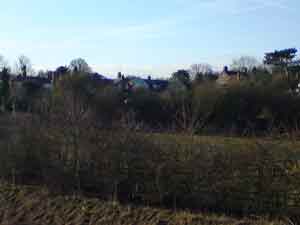
Route of HS2 Next to A413 in Wendover

High Speed Line Will Plough Through Houses to the Right

Houses to be Demolished on Railway Route

Houses in Wendover to be Demolished on Railway Route

The line will then stretch from Wendover across the relatively flat ground of Aylesbury Vale — see below.
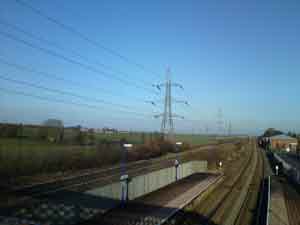
Route of HS2 at South Of Aylesbury Vale

The HS2 Line will be built just to the left of the road

From Wendover the line slices through the edge of Stoke Mandeville, just by the Goat Centre, and then passes very close to the Aylesbury outskirts of Hawkslade Farm, Southcourt, Walton Court and Fairford Leys before heading towards Waddesdon and Quainton — where it will cut across some maize fields that I found difficult to negotiate on the Aylesbury Ring last year. It’s about the only good thing about the route that instead of clearing a metre wide strip from his crops then the farmer will have a 75m wide railway run through them — no doubt farmers will be some of the few who will be reasonably compensated.

Maybe the government would like to have local residents believe that its highly paid consultants have been poring over various route options for the proposed High Speed 2 rail line in painstaking detail, carefully balancing environmental considerations against engineering requirements.

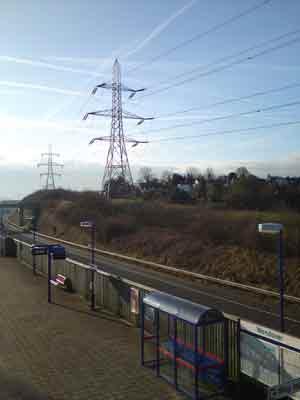
There is an alternative view. Consider that, as the route carves chunks out of the Chiltern chalk and then rises on high viaducts and embankments to dominate Aylesbury Vale, how close its alignment is to an existing disfiguration of the local landscape: the high-voltage electricity lines that stretch from the substation near Amersham, through Wendover, past Aylesbury and through Quainton. The routes align to within a couple of hundred yards for almost all their lengths.

Perhaps the planners took one look at the rows of hundred foot pylons and thought ‘if they can put up with those then maybe we can sneak in a 250mph railway line?’ Wrong. While visually obtrusive the electricity wires do not create the massive environmental disturbance, both permanently by despoiling the countryside and operationally by inflicting massive noise pollution.

Such is the scandalous lack of environmental consideration in the current plans that it’s easy to believe the planners have performed such a casual and perfunctory assessment of the route as to stand on Coombe Hill and play join up the pylons. Here’s a view of how the pylons march through the pass from Missenden into Wendover and perhaps encouraged the railway to follow.
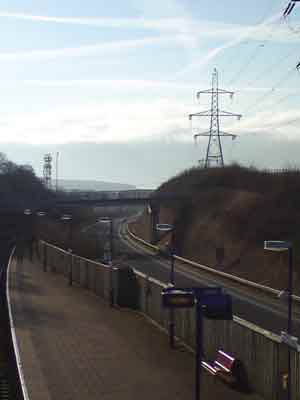
Wendover Pass

The Pass Through the Chilterns at Wendover

Overall, high speed rail is a good idea and the route has to go somewhere but this seems like the cheapo option that avoids towns like High Wycombe and Watford that would require extensive tunneling to pass — and cheapo means it goes through unspoilt countryside and skirts a large population centre, neither of which currently has any existing mass transit corridor. The lack of consideration of deep tunnelling near Wendover and in the Chilterns and when the line is near Aylesbury is scandalous.

Brown — His Clunking Vanity Destroys All Before Him

Monday, March 15th, 2010

I’m starting to get worried. We’re not in the official election period yet and I’m already starting to get apoplectic about Brown’s behaviour. Perhaps if I get things off my chest earlier then I can have an election-free blog (little hope of that).

Here’s just a short taste of the way his world view seems to be twisted to serve his own vanity.

Firstly, the BA strike. Despite his party taking more funding from Unite than any other donor he’s cynically pocketed that and made a facile declaration of support for the aggressive tactics of BA management — clearly without taking the trouble to realise that their tactics are deliberately undermining the democratic and lawful ability of worker to engage in industrial reaction. What is so “unjustifiable” at a union scheduling industrial action when it has a mandate from the staff involved of about four to one in favour. It would be unjustifiable if it did not. Moreover, BA management made a calculated offer that it knew it would withdraw as the union had to call industrial action within a certain period of the ballot result. Basically Brown does not want a strike in an election period and he is prepared to compromise the principles on which the whole history of his party has been founded so he can limp on further like a wounded animal.

Secondly, his comments on continuing on as Labour leader if the party loses its overall majority are to use his own words ‘deplorable and unjustifiable’. According to the BBC website said: ‘I think I owe it to people to continue and complete the work that we’ve started of taking this country out of the most difficult global financial recession.’ This is completely deluded as which people does he owe anything to — that suggests that someone voted him into his current office. However, no-one has voted for Brown as Prime Minister — not even the spineless parliamentary Labour party voted him as leader. He has no mandate from anybody and it’s his own vain, ego-driven self-appointment as saviour of the world economic system that he’s deluded himself into thinking he’s a duty to continue.

His grip on reality seems to be as removed as his many enemies in the Labour party would have us believe.

Dave on the Verge of Treason?

Tuesday, March 2nd, 2010

The poll in the Sunday Times that gave the Tories a lead of  only two points is a wake up call for everyone with an interest in politics. It is a very damning verdict on the competence of Cameron and also shows the lasting hostility to the Tories nearly 20 years after their removal of Thatcher’s divisive influence. I have a theory that Thatcher’s worst legacy was to leave an embittered and deeply politicised academic and cultural establishment which became receptive to the abhorrent and cynical use of political correctness (for want of a better description) as a neo-Stalinist tool of power and manipulation that has been the most insidious hallmark of New Labour — something that will wreak far more long-lasting damage to the country (IMHO) than anything Thatcher did.

This fairly superficial embitterdness towards the Tories seems to suggest that there isn’t the sort of popular acclaim for removing this clapped-out disgrace of an administration that there was with Major in 1997 — ironically a government now which seems to have been the most effective of the last 50 years (so much for the threat of hung parliaments). Even so, I think the whole country would want to see Cameron and company ritually disembowelled if they wake up the morning after a general election to see Brown’s psychotic grin as he walks back into Number Ten — no doubt with Alistair Darling, James Purnell, Caroline Flint and the rest on their way to the Gulag as he preaches about a listening government of all the talents.

Almost all Labour MPs seem to realise it’s in their best interests for Brown to lose by a small majority so they can cast him out to howl impotently with his forces of hell (Balls) and that they could look forward to a fairly new election with a leader who’s a member of the human race. Personally I’d consider voting for a Labour Party led by Darling — the only one with any guts shown in the last couple of years.

There are really two words that describe Cameron’s biggest mistake — George Osborne. Bad enough that Cameron is an Eton toff but at least he presents a semblance of humanity. Osborne both looks and acts irredeemably like a complete anachronism and irrelevance to the vast majority of the voting public — an image of the Tory party that goes back to Douglas Home and Eden. He reminds me of that awful upper-class ventriloquists dummy that Ray Alan (remember him) used to turn up with on dire 70s variety shows — mind you the dummy showed more independence of thought and character than most Labour MPs.

I’ll be disenfranchised — voting in Bercow’s constituency so no Labour, Tories or Lib Dem candidates. Should UKIP stand I certainly wouldn’t vote for them but I’m hoping the Greens put someone up. While I disagree strongly with a lot of their practical policies, I have great sympathy with their basic premise — that global capital is a rapacious monster that’s defiling and destroying the world for the benefit of few but the very richest elites — which makes it bizarre that Brown and Blair so worshipped it.

I also like the practical application of green principles — protecting nature, growning your own and so on and I took delivery of a box full of seed potato and onion sets yesterday to prove it. Give a man a potato and you feed him a bag of crisps, give him a seed potato and some soil and (in my case) you get the magic of digging up a few knobbly organic specimens and you give the slugs a feast.

RIP ‘Caring Capitalism’

Tuesday, January 19th, 2010

The Quaker founders of Cadbury’s will be gyrating in their graves after the company — an original model of benevolent capitalism — has been sold out by its management to bland global capital processed cheese makers. It might be an appropriate epitaph for the era of New Labour — so much meaningless bluster and posturing (such as came from Mandelson’s reported hostility to the bid) ends up being utterly cynical and worthless.

Maybe it’s appropriate for the times. The Cadbury family cared enough about the people who worked in their Bourneville factory that they built houses (with gardens) for their Victorian workers and set up other countless benevolent institutions for their workforce.

New Labour have been mystifyingly craven towards global capital so it’s perhaps appropriate that they impotently preside over the destruction of one of the last companies that seemed to offer a compromise between the naked greed of capital and the humane welfare of the people who worked in that organisation.

If ever there was an award for meaningless, misleading and insincere prattle it should go to Mandelson’s words on Cadbury as reported in ‘The Times’: ‘Lord Mandelson, who was unable to intervene in the bid process, nonetheless warned Kraft last month: “If you think that you can come here and make a fast buck you will find that you face huge opposition from the local population . . . and from the British Government.”’

Let’s see what he does rather than says.

The Intellectual Life of the British Working Classes

Tuesday, January 5th, 2010

There’s a new edition of this book by Jonathan Rose being published in April — and I will pre-order it. It has superb reviews — both online and published, including this one from the Independent.

How apt it will be published just before the hopeful demise of the regime that has been on an apparent mission to destroy the culture of aspiration and dignity of the working class. Over the past 12 years, New Labour, especially Brown, has tried, whether by design or blundering accident, to eradicate the working class as it has been known for over a century. Their aim has been to destroy the working class and separate it into aspirant middle class (smug ex-students like most New Labour MP) or to consign people to be the helpless, infantile, hopeless, feral clients of Brown – his underclass.

The review from the Independent notes how the book mourns the “demise of the British working-class intellectual, [and is] a noble elegy over the greatest days and highest hopes of what was always the most solid, settled, self- confident and unrevolutionary working class in industrial history.” 

There’s a nice review from The Guardian online which self-reflexively pokes fun at its own: ‘It has become an axiom of cultural studies that the dominant class defines and maintains the value of high culture – live white males choosing dead white males for the rest of us to admire. Rose suggests that, given a choice, the working classes in fact chose exactly the same Great Books to canonise, from the Odyssey to Dickens. Indeed, on the evidence of the borrowing records from Welsh miners’ libraries, the only books that no one wants to read are the works of the literary modernists. One does still occasionally come across people who seem to assume that the words “working class” are a synonym for “stupid” or “wicked” or “lazy” or “dumb”. The people who make such assumptions would do well to read The Intellectual Life of the British Working Classes , but most of them are probably too busy working in TV, or on newspaper colour supplements, or writing fancy books that nobody wants to read.’

New Labour, their apologists and allies in the media are marked by their ingrained urge to to simplify and patronise culture — afraid that ‘the kids on the housing estates’ won’t ‘get it’. (Note the wearisome recurrence of grim housing estates and suburbia in Russell T. Davies’ Doctor Who episodes — maybe the BBC told him there had to be an equal number of inner-city ‘kids’ to aliens or Daleks to maintain balance?) However, the traditional, dignified working class has never required to be talked down to, as Fred Inglis says in the Independent: ‘This is an incomparable book: scholarly to a scruple; majestic in its 100-year reach; ardent in its reaffirmation of faith in what good books, splendid music and fine art may do to turn a people’s history into a long revolution on behalf of liberty, equality and truth.’